
I Retired at 52. It Lasted Three Weeks.
16 September 2026 · 6 min read · by Steve Potter
I retired at 52.
That sounds like the perfect ending to a property story.
Except my retirement lasted about three weeks.
It was February. My friends were still at work. Debbie was still working in her business, Ironing Maiden. And I suddenly had something I'd spent years trying to create: nothing I had to do.
I hated it.
Not because property hadn't worked. It had done exactly what I'd asked it to do. The problem was that I'd misunderstood what I actually wanted. I'm a problem solver. Give me an empty diary and tell me to find something to do until everybody else finishes work, and that's a completely different matter to giving me a problem to solve.
Property didn't give me a life where I never worked again. It gave me the ability to choose what I worked on. Looking back, that's what I actually wanted. I just didn't understand the difference at the time.
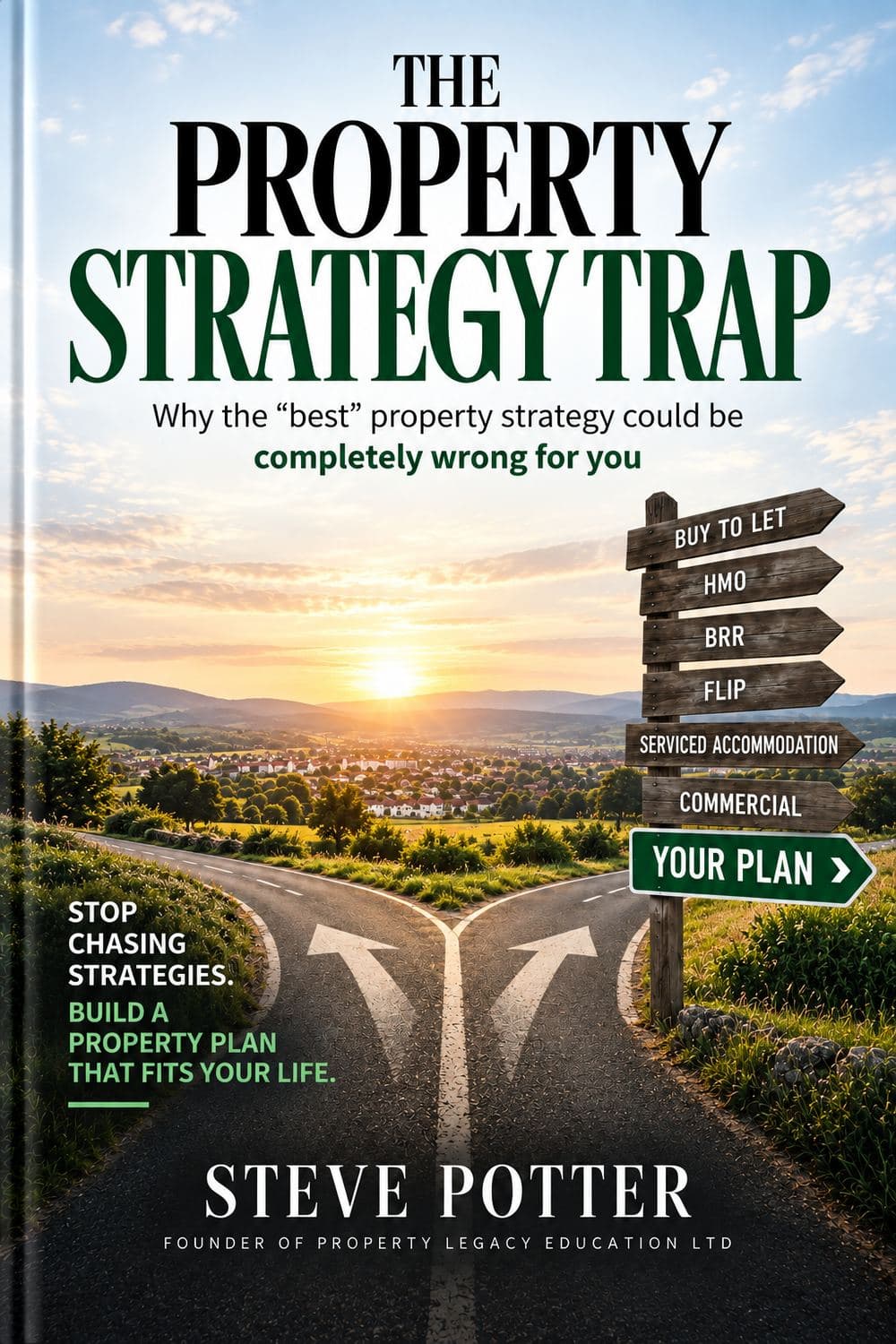
That story is the reason I wrote The Property Strategy Trap.
Property isn't the destination. Property is the vehicle.
Most property education starts with the wrong question: which strategy is best? Buy-to-let investors will tell you to buy buy-to-lets. HMO investors will show you why HMOs produce better cash flow. Someone running serviced accommodation will explain why you should be doing serviced accommodation.
Here's the confusing part. They might all be right.
I've used several different strategies myself. Straightforward buy-to-lets. Investors. Refurbishments. Serviced accommodation. Purchase lease options. I've bought, developed, refinanced, and sold. Those strategies can work. But that doesn't mean any of them is right for you.
Imagine walking into a car dealership and asking, "What's the best vehicle?" There isn't enough information to answer the question. Are you taking four children on holiday, driving around central London, moving building materials, or travelling across Europe? Until I understand the journey, recommending the vehicle is almost meaningless.
Property is no different. And the purpose of the book is to help you work out what that vehicle actually needs to do for you, before you pick one.
Nobody asks which tool is best
There's a second idea in the book I think matters just as much. Imagine I put a hammer, a screwdriver, a drill, and a saw on a table and asked, "Which is the best tool?"
You'd ask: best for what?
A hammer is excellent for driving a nail and hopeless for tightening a screw. Buy-to-let isn't inherently better or worse than serviced accommodation. An HMO isn't automatically better because the gross rent is higher. They do different jobs. So the book keeps coming back to one question instead of "which strategy makes the most money": what job do I actually need this strategy to do?
I didn't start with the money either
Before any of this, there was a more basic problem. When I decided I was going to invest in property, I didn't have the money.
Debbie, my girlfriend at the time, knew our financial position as well as I did. So when I started talking about buying investment property, her response was completely reasonable: "Where is the money coming from to buy the house?"
My answer wasn't especially reassuring: "The deal is the most important part. The finance is almost insignificant."
I explain in the book exactly what that does and doesn't mean, because it's easy to turn a line like that into nonsense. I'm not saying you don't need money, or that finance doesn't matter, or that anybody can build a portfolio with no resources at all. My point was simpler: if I'd started with "how much money have I got," I'd never have started. So I started with "can I find a genuinely good deal" instead, and treated the finance as a problem to solve once I had an answer.
My first buy-to-let cost £109,000. An investor provided the deposit. A mortgage provided the rest. My own initial cost was roughly £800 in legal fees. The full story, including what happened five years later, is already on the blog if you want the longer version.
What's actually in the book
The Property Strategy Trap is a 141-page digital edition with a fillable workbook, not 141 pages of theory followed by a sales pitch. You build your own plan as you go through it. The chapters are:
- What Are You Actually Building? — starting with the destination, not the property
- Start Where You Actually Are — an honest look at your real position
- Stop Falling in Love With Strategies — the hammer-and-screwdriver chapter
- A Good Deal Can Be the Wrong Deal — testing whether an opportunity actually deserves your resources
- Finance Follows the Deal — how the money gets in, and how it gets back out
- Build Your Property Legacy Plan — bringing everything together into one practical plan
- The Next Deal Isn't the Goal — what comes after the plan
It's £4.99, one-off payment, instant access. It won't tell you which strategy to use. That's deliberate, the whole point is helping you work out which one actually fits your destination, resources, and boundaries, not mine.
Steve Potter
Steve Potter is the founder and CEO of Property Legacy Education Ltd, along with five other successful property companies. With a proven track record in the property investment world, Steve built a £1.3 million property portfolio in just three years. He is passionate about helping others achieve financial freedom through strategic property investment. As the author of two #1 Amazon best-selling books, Steve regularly shares his expertise through blogs, consultations, and speaking events. With a background in electrical engineering and a sharp focus on scalable investment strategies, Steve provides practical guidance for investors at all levels, empowering them to build thriving property businesses.